
The cardisiography provides the display of the extended leads V7-V9 and Vr3-Vr6.
Cardisiography – the first ESC guideline-compliant and AI-assisted heart check-up!
With the 2023 ESC guidelines, the leads V7-V9 and Vr3-Vr6 were officially included in infarction diagnostics – particularly in suspected posterior or right ventricular myocardial infarction. They enable a more targeted assessment of infarction types that are often missed in a standard ECG.
A clear advantage of cardisiography (CSG)
These leads are recorded automatically – without the need to reposition electrodes or perform multiple recordings, as is often required with conventional methods for V7-V9 and Vr3-Vr6. Thus, cardisiography is the first ESC guideline-compliant and AI-assisted heart check-up.
V7–V9: Posterior wall diagnostics
These leads are used to better visualize posterior ST-segment changes.
- Positioning: The limb leads as well as V4–V6 remain in their conventional positions. The electrodes from V1–V3 are repositioned to:
- V7: posterior axillary line, level with V4
- V8: mid-scapular line, level with V4
- V9: paravertebral line, level with V4
- Clinical benefit: V7–V9 allow the identification of ST elevations in posterior wall infarctions that are not visible in a standard 12-lead ECG.
Vr3–Vr6: Extended right heart diagnostics
These leads are used primarily in inferior infarctions to assess possible right ventricular involvement.
- Positioning: The electrodes V1, V2, as well as the limb leads, remain in their standard positions. The following electrodes are added:
- Vr3: between V1 and Vr4
- Vr4: 5th intercostal space on the right, mid-clavicular line
- Vr5: right anterior axillary line, level with Vr4
- Vr6: right mid-axillary line, level with Vr4
Guideline recommendation according to ESC 2023:
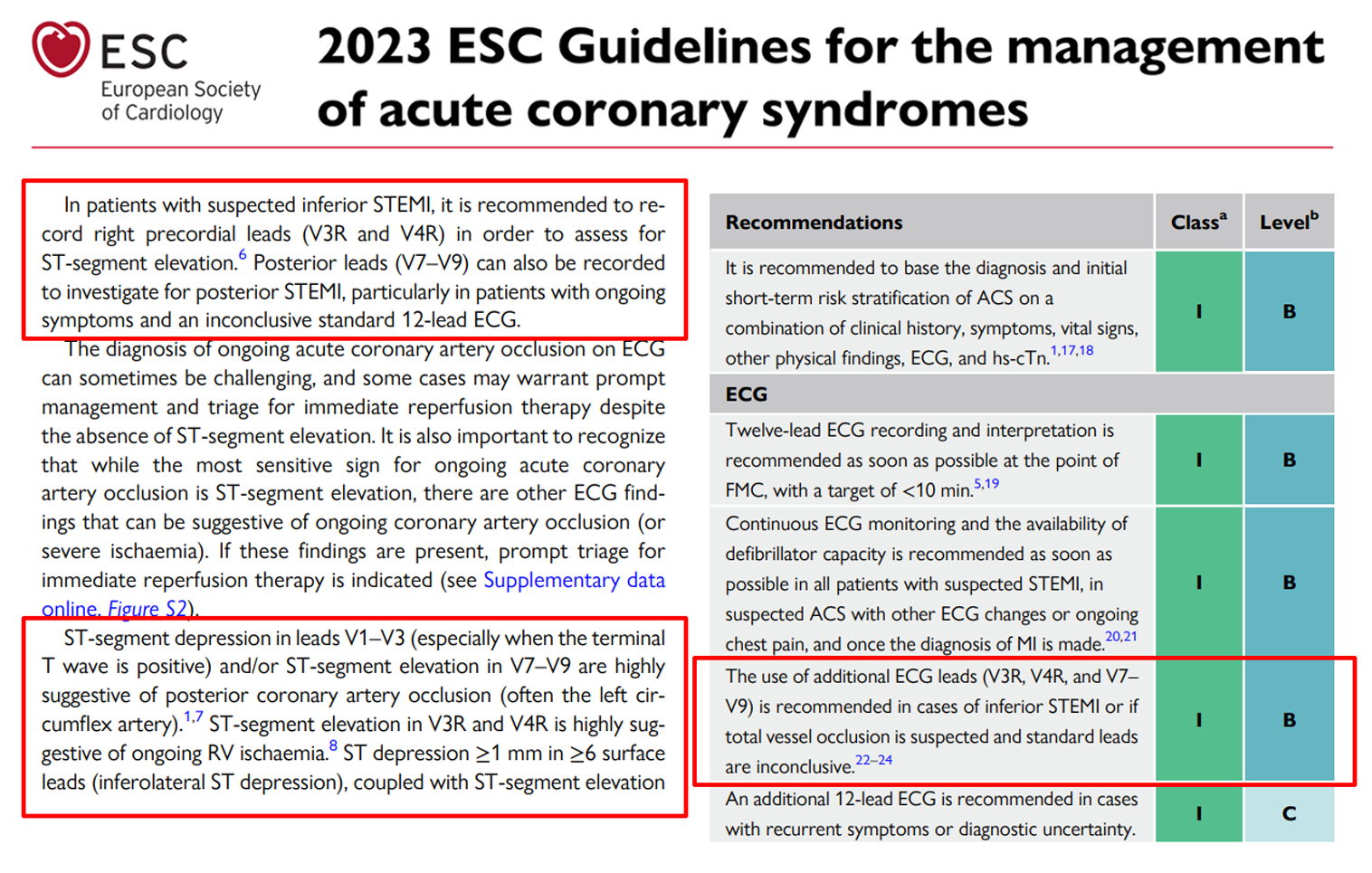
The European Society of Cardiology (ESC) explicitly recommends in its current guidelines the use of extended ECG leads (V3R, V4R and V7–V9) to improve the diagnosis of posterior and right ventricular myocardial infarctions – particularly when findings in the standard 12-lead ECG are inconclusive.
The following graphic shows the excerpt from the 2023 ESC guidelines regarding the use of the additional leads:
Cardisiographs comply with the standards and regulations EN 55032:2015 Class B, EN 55024:2010+A1:2015, and 47 CFR Part 15.
Disclaimer: All content is created with the utmost care. However, the providers do not assume any responsibility for the accuracy, completeness, or timeliness of the information provided. The use of the content is at the user’s own risk.