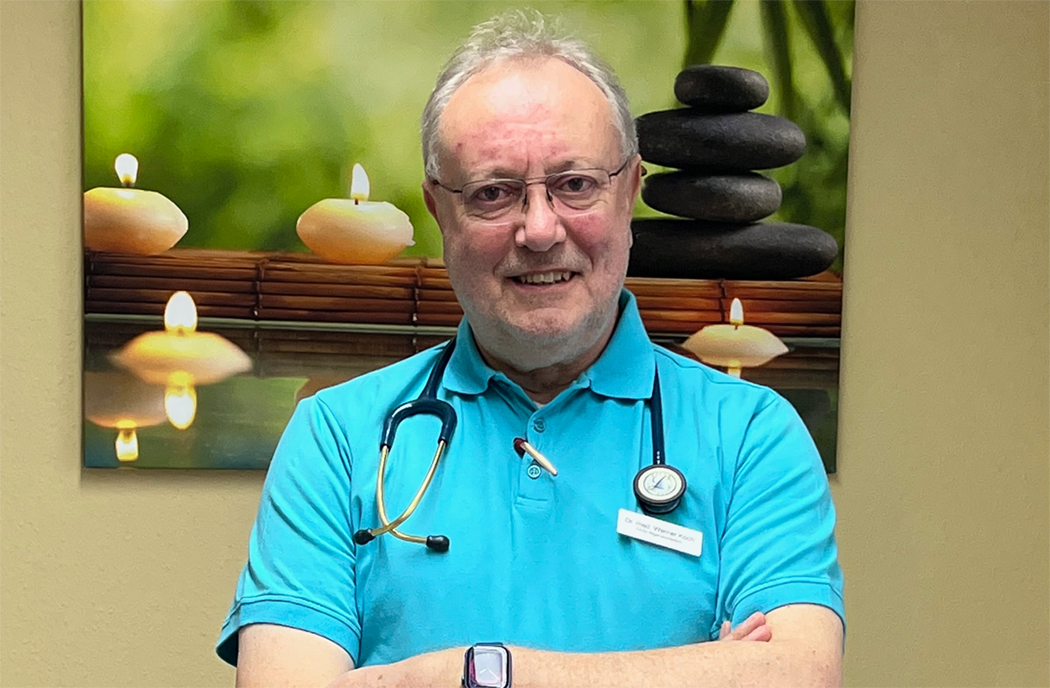
“Why should I perform an ECG that detects only a fraction of heart problems when there is a much more precise and informative diagnostic method?”
“I am deeply grateful to God that I am able to offer cardisiography in my practice. We have already carried out nearly 550 measurements—and in doing so have demonstrably saved at least 20 people from a heart attack and at least 5 people from certain death.
My goal is to keep people healthy for as long as possible. I always say: prevention is more valuable than the best therapy. That is why cardisiography fascinates me. As a physician and a graduate engineer, I support this technology with both heart and mind, because it serves people and helps us doctors detect heart problems earlier and more precisely, prevent heart attacks, and save lives.
I have eliminated the standard ECG from my practice. Why should I perform an ECG that detects only a fraction of heart problems when there is a much more precise and informative diagnostic method?
I would like to share three striking patient cases involving cardisiography: On the third day after acquiring the device, we had our first patient with a highly red result. I referred him to a cardiologist for further evaluation and did not see him again for quite some time. More than a year later he returned. He had shown the cardiologist the PDF report from the cardisiography. However, the cardiologist was unfamiliar with the procedure and essentially asked, “What is this?” He performed his own conventional diagnostics and certified the patient as having good heart health. Just under a year later, the patient suffered a heart attack. Fortunately he survived and received two stents. What fascinates me is that cardisiography had clearly shown a year earlier that the patient’s heart was not in good condition.
Another case: a 57-year-old man, a bodybuilder type, extremely well trained. He had already received two stents and believed his heart was in perfect condition. However, the measurement revealed severe circulatory disorders—progression of his coronary heart disease. After further examinations he received additional stents. Without the abnormal result in the cardisiography, he probably would not have lived to see the next Christmas.
A third remarkable patient case involves an 80-year-old hairdresser—a prime example of how much people can do for their own health. He has always been very active, has practiced Reiki for decades, pays close attention to his diet and health, and has taken dietary supplements for 40 years to optimize his values. He came to my practice feeling very fit and healthy. He had never expected to have heart disease. Through cardisiography we discovered a dangerous circulatory disorder—a problem that might otherwise have been detected far too late. He required three stents and even a new heart valve to stabilize his heart again.
It frustrates me enormously that policymakers fail to recognize the opportunities of prevention—even if only to save billions in treatment costs—for the sake of my patients as well. I run a private practice. With a statutory insurance contract I would not be able to ‘survive.’ However, more than 50 percent of my patients are publicly insured. They pay for private treatment, including cardisiography, themselves because they appreciate my commitment to preventive healthcare. I am available to my patients 24/7, work fully digitally, including through an app, and even make house calls. For that I receive just €3.58 in travel allowance.
When I think about politicians and health insurance funds, I often ask myself: ‘Are they trying to make a fool of me?’ Private physicians are considered the ‘idiots of the nation.’ Everyone thinks we wake up in the morning wondering which of our three Porsches we should drive today. What nonsense. In 1996 we received 20 Deutsche Mark for ten minutes of consultation—today it is €10.72. Any lawyer would laugh at such an adjustment in fees. For us, however, this has been reality for 30 years, even though our costs keep rising.
I love my profession, and if I did not have this passion for medicine and for people, I would not do all of this. I am now 66 years old and hope that God will continue to be kind to me so that I may help people for many more years. At the same time, I hope that prevention in Germany will finally be compensated better—that all health insurers will pay for modern and meaningful examinations such as cardisiography, and that doctors will finally receive better remuneration for their commitment to prevention. Because smart prevention, such as the early detection of heart disease, not only saves lives but can also avoid enormous costs for treatments and heart surgeries.”
Dr. med. Werner Koch
General Practitioner, 54584 Jünkerath, Germany (https://privatpraxis-dr-koch.de/leistungen/cardisiographie/)
April 2026